What Is Chlorine? 
Chlorine is a chemical. It belongs to the halogen group and is widely used as a disinfectant because it kills bacteria, viruses, and other pathogens effectively and affordably. This is exactly why it is commonly added to municipal drinking water supplies and swimming pools.
What Are the Risks of Chlorine in Water?
At the low levels used in treated drinking water. chlorine is considered safe for most people. However, you might still experience some noticeable effects :
- An unpleasant taste or smell.
- Mild skin or eye irritation with prolonged exposure, especially for sensitive individuals.
How Can You Tell If Your Water Has Chlorine?
Smell and Taste : You can usually identify chlorine in your water by its distinct chemical or “swimming-pool” taste and smell.
Test Strips : Inexpensive paper strips change color based on chlorine concentration, making them cheap and easy for home use.
Liquid Test Kits (DPD method) : A reagent is added to a water sample, turning it pink. The intensity correlates with the chlorine concentration when compared to a color chart.
Digital Meters and Lab Testing : For precise, verified results, digital colorimeters or certified water-testing labs are the best options. You can also compare your readings to your local water utility’s published annual water quality report.
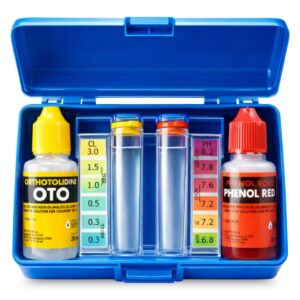 Liquid Test Kits
Ways to Remove Chlorine from Your Water If you want to enjoy chlorine-free water, there are several methods available :
- Natural Methods
- Let the Water Stand : Leave water uncovered in a bucket or large jar for 24–48 hours to let the free chlorine naturally evaporate.
- Sunlight : sunlight can speed up the breakdown and evaporation of chlorine.
- Aeration : Using an air pump with an air stone to create bubbles for 4–6 hours is a common method used to quickly prepare water for aquariums.
- Using Equipment or Chemicals
- Boiling : Boiling water for 15–20 minutes helps accelerate the evaporation of free chlorine.
- Sodium Thiosulfate : Adding this neutralizes chlorine almost instantly, which is widely used for aquariums where chlorine-free water is needed immediately.
- Whole-House Water Filtration : Using an active carbon filter is one of the most effective and convenient ways to remove chlorine, instantly improving both the taste and odor of your water.
If you’re looking for a water purifier that effectively removes chlorine and is safe for your health, talk to us. We specialize in whole-house point-of-entry water purification. Our main BIG F PRO systems feature a 5-micron active carbon filter specifically designed to eliminate chemical residues and the taste and smell of chlorine from every tap in your home. The active carbon filter works as the second step in a complete purification process. First, a sediment filter removes physical dirt, sand, and silt. Then, the active carbon filter removes the chlorine and chemical residues. Finally, and most importantly, a high-output UV-C purification lamp kills of invisible viruses and bacteria that can make us sick. This complete system provides your entire home with drinking-water quality straight from all outlets. As well as the taste and smell of chlorine from your water. However, once that chlorine is removed, the water no longer has any chemical protection against microbes. In fact, removing chlorine without replacing it with a new disinfection method can actually increase your microbiological risk.
This is exactly why we always pair carbon filtration with UV-C purification. While the carbon filter removes the chemicals and smells, the high-output UV-C lamp acts as the essential final barrier, killing of invisible viruses and bacteria that can make us sick. By placing the UV-C system as the very last step before water enters your plumbing (after your water tank and pump), we ensure the water is disinfected as close to your taps as possible, preventing any recontamination that often occurs when water sits in storage tanks.
References :
https://www.facebook.com/share/p/1D5zhsLpk2/